About Ancestry Research
Behind every unit number and regiment name is a person — a grandfather, a great-uncle, a father who never spoke much about the war. We dig through military records, unit histories and battlefield archives to find out where your relative served, what they lived through, and exactly which stretch of ground they fought on.
Then we take you there ourselves. Not a generic battlefield tour, but a personal one — built around your family's own story, told on the beach, the ridge, or the village street where it actually happened.
Standing Where Your Family Stood
Four case studies below — we'll be adding more family stories as we help new families trace their history.

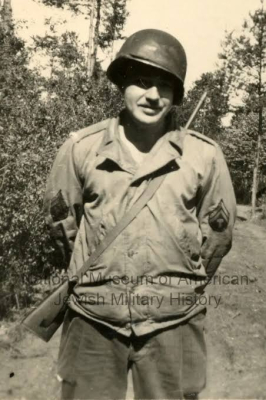
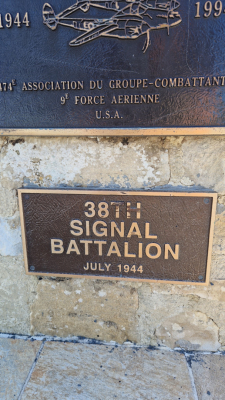
Sidney Talmud — 38th Signal Battalion
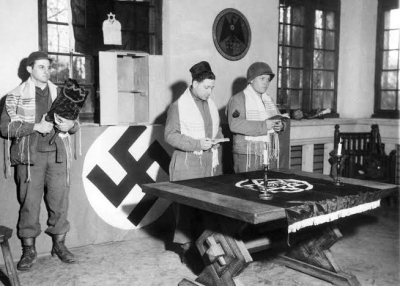
In the middle of March, 1945, Corporal Sidney Talmud was approached by Lt. Shubow, their Jewish chaplain. He planned to conduct Passover services, and since Sidney was the only Jewish cook in the battalion, would he supervise the food arrangements.
The next two weeks were hectic. They had been moving through Germany and finally stopped at München Gladbach (60 miles northeast of Noorbeek, the Netherlands). Sidney solicited all canned goods from Jewish soldiers and they responded generously. He passed the word to the scroungers that he needed fresh potatoes — and soon had a truckload.
Erev Pesach (Eve of Passover) came and the chaplain directed their convoy several miles to an imposing building called "Schloss Rheydt" — Goebbels' castle. Directly off the veranda, where Sidney set up two gasoline camp-stoves, was a gigantic banquet room that would easily accommodate the 300 GIs he would feed.
On one wall was a picture of Hitler and one of his buddies had scrawled "Kaput" across it.
While frying latkes, a fellow came by and inquired what he was doing. Sidney offered him some pancakes while he explained their presence. The latkes agreed with him — he kept eating them and asking questions. That night his story flew across the Atlantic cable, and Sidney's parents were interviewed by Time and the papers, and WEVD. They planted trees for him in Israel.
When all the latkes were fried and eaten, Sidney joined his comrades in Passover songs. They had seen the atrocities and now they were savoring some small measure of vengeance and victory.

Elden R. "Dan" Burdin — 82nd Airborne / 507th Parachute Infantry Regiment
Tech Sergeant Elden R. "Dan" Burdin served with the 507th Parachute Infantry Regiment, 82nd Airborne Division. With only four practice jumps behind him, he dropped into the darkness over Sainte-Mère-Église on the night of June 5–6, 1944, a .30 caliber machine gun strapped to his gear.
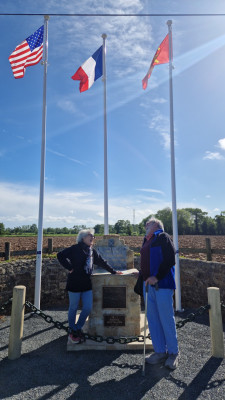
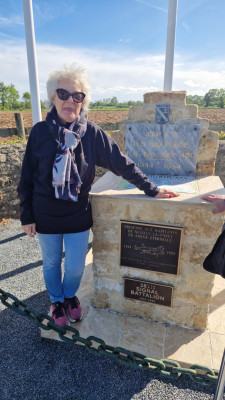
His unit fought to hold the bridge at Chef-du-Pont over the Merderet river — a crossing point the Germans desperately wanted back. His family later stood beside that bridge during their research trip to Normandy.
Burdin went on to jump into Operation Market Garden in Holland and pushed with the 82nd Airborne toward Germany. "The Germans knew we were coming," he recalled decades later, "St. Lo was bloody." Of the roughly 150 men who jumped with his group that night, only 15 made it back — many wounded, captured, or killed.
For his service he was awarded the Bronze Star and Purple Heart. His family's research traced his full path — from the jump fields of Sainte-Mère-Église to the riverbank at Chef-du-Pont — turning a name on a newspaper clipping into a place they could stand and remember him.

John Carl Strother, Jr. — 9th Infantry Division / 39th Infantry Regiment
In June 1944, the 9th Infantry Division — including the 39th Infantry Regiment — crossed the Channel bound for Normandy. On D-Day plus four, June 10, 1944, the Regiment landed at Utah Beach.
On June 12th, the 9th Infantry Division began a series of battles that led to the race to the sea and the eventual sealing off of the Cherbourg Peninsula. The battle for the Cotentin Peninsula began on June 18th, 1944. The 39th Infantry Regiment excelled at Anderville, which fell on July 1st, yielding 3,000 prisoners.
Next followed the famous "Battle of the Hedgerows" — the large earth walls covered with dense bushes and trees that divided the farming fields of Normandy. For 25 days, the men of the Fighting Falcons fought, bled, and died in one of the bloodiest battles of the war.
After the breakthrough at St. Lô, the 39th Regiment raced across France, tangling with the retreating Germans at every town and crossroads where they chose to stand and fight. John Carl Strother, Jr., of Company K, was killed in action on August 8, 1944, at Mortain.

Lieutenant Camille M. Lelong — BCRA, Jedburgh Team Bruce
Lieutenant Camille M. Lelong served with the BCRA — the Free French intelligence and special operations bureau — as a member of Jedburgh Team Bruce, parachuted behind German lines to arm and coordinate the French Resistance ahead of the Allied invasion.
JEDBURGH was a special forces operation carried out by the Allies during WWII, aimed at coordinating the action of the Resistance with the general plans of the Supreme Headquarters Allied Expeditionary Forces (SHAEF). Men of the British Special Operations Executive (SOE), the American Office of Strategic Services (OSS), and the Free French BCRA, together with soldiers from the armies of France, Belgium, and the Netherlands, were parachuted in uniform behind German lines to lead sabotage and guerrilla actions and to coordinate the Resistance.
About 100 Jedburgh teams were dropped into France, Belgium, and Holland between June and December 1944. For his service with Team Bruce, Lieutenant Lelong was awarded the Croix de Guerre (France), the Bronze Star (United States, twice), and the Medal of Freedom (United States).
From a Name to a Place
Tell Us What You Know
A name, a unit, a division, a few letters or photos — whatever you have is enough to start.
We Research
We dig through military records, unit war diaries and battlefield archives to trace their service.
We Build Your Route
We map the ground they crossed and design a private itinerary around their story.
You Walk the Path
Your guide takes you there in person, sharing the history at every stop along the way.
Practical Information
Start Tracing Your Family's Story
Did a family member fight in Europe during World War I or World War II? Send us their name, unit, or division and let us take it from there. It's often described as the most meaningful day of a family's trip to France.